
Scoliosis Surgery in India in India
Compare hospitals, specialists and costs for scoliosis surgery in india — and get a personalised quote from Medworld India within 24–48 hours.
- Available at
- 6 hospitals
Overview
Advanced Surgical Treatment for Spinal Curvature
Scoliosis surgery is performed to treat certain cases of abnormal sideways curvature of the spine. While many people with scoliosis may be managed with observation, exercise, bracing, or other non-surgical approaches, surgery may be considered when the spinal curvature is severe, progressive, or significantly affecting the patient's health and quality of life.
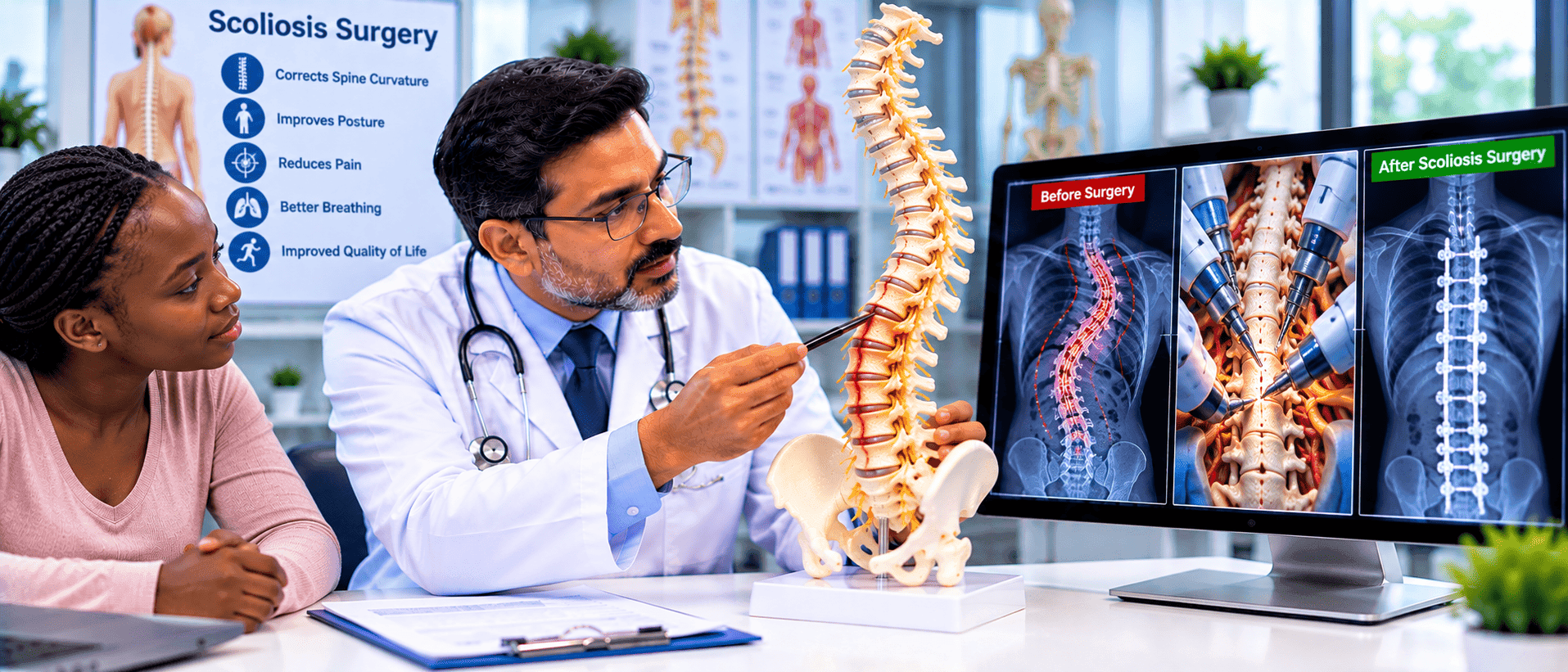
The goal of scoliosis surgery is generally to correct or reduce the spinal curvature where appropriate, improve spinal alignment, and stabilize the affected section of the spine.
What Is Scoliosis?
Scoliosis is a condition in which the spine develops an abnormal sideways curve. The curve may occur in different areas of the spine and can vary in severity.
Some cases develop during childhood or adolescence, while others may occur or progress during adulthood due to degenerative changes or other spinal conditions.
The severity and progression of scoliosis are evaluated through physical examination and imaging studies.
When Is Scoliosis Surgery Recommended?
Scoliosis surgery may be considered based on several factors, including the severity and progression of the spinal curve, symptoms, age, overall health, and the underlying cause.
Surgery may be considered in selected patients when:
- The spinal curve is severe or continues to progress
- The condition significantly affects posture or balance
- Persistent pain affects daily activities
- Non-surgical treatment has not provided sufficient benefit
- The spinal deformity causes significant functional problems
- Nerve compression is associated with the spinal deformity
A qualified spine specialist will determine whether surgery is appropriate for each individual patient.
Types of Scoliosis Surgery
Spinal Fusion Surgery
Spinal fusion is one of the most commonly used surgical approaches for scoliosis. During the procedure, selected vertebrae are joined together to stabilize and support the corrected spinal alignment.
Specialized implants, such as rods and screws, may be used to help maintain the position of the spine while fusion occurs.
Posterior Spinal Fusion
Posterior spinal fusion is performed through the back of the body. It is commonly used to treat different types of scoliosis and may involve spinal instrumentation to support alignment and stability.
Anterior Spinal Fusion
Anterior spinal fusion involves accessing the spine through the front or side of the body in selected cases.
The most appropriate approach depends on the location and nature of the spinal curvature.
Growing Rod Surgery
Growing rod techniques may be considered for selected children with early-onset scoliosis. These techniques are designed to help manage spinal curvature while allowing continued growth.
The suitability of this treatment depends on the child's age, spinal development, and medical condition.
Conditions and Types of Scoliosis
Scoliosis can occur for different reasons. Common categories include:
Idiopathic Scoliosis
This is a common form of scoliosis in which the exact cause may not be clearly identified.
Congenital Scoliosis
Congenital scoliosis is associated with abnormalities in spinal development that are present from birth.
Neuromuscular Scoliosis
This type of scoliosis may develop in association with certain neurological or muscular conditions.
Degenerative Scoliosis
Degenerative scoliosis may develop in adults due to age-related changes affecting the spine.
Benefits of Scoliosis Surgery
Depending on the patient's condition and surgical approach, scoliosis surgery may help:
- Improve spinal alignment
- Reduce or prevent progression of the spinal curve
- Improve spinal balance
- Stabilize the affected area of the spine
- Reduce symptoms associated with spinal deformity
- Improve posture and overall function
Treatment outcomes vary depending on the severity of scoliosis, the patient's age, overall health, and other individual factors.
How Is Scoliosis Surgery Performed?
The exact procedure depends on the type and severity of scoliosis. However, the treatment process generally includes:
1. Comprehensive Evaluation
The specialist reviews the patient's medical history, symptoms, physical condition, and imaging studies such as X-rays, MRI, or CT scans.
2. Surgical Planning
The surgeon develops a personalized treatment plan based on the location and severity of the spinal curvature.
3. Spinal Correction and Stabilization
During surgery, specialized techniques and instrumentation may be used to improve spinal alignment and stabilize the affected vertebrae.
4. Spinal Fusion
In many scoliosis procedures, selected vertebrae are fused together to support long-term stability.
5. Recovery and Rehabilitation
Following surgery, the patient receives monitoring, pain management, mobility guidance, and rehabilitation support as needed.
Recovery After Scoliosis Surgery
Recovery after scoliosis surgery varies depending on the type and complexity of the procedure, the patient's age, and overall health.
The recovery process may include:
- Hospital monitoring after surgery
- Pain management
- Gradual mobility and walking
- Physiotherapy and rehabilitation when recommended
- Follow-up appointments and imaging
- Guidance for returning to school, work, and daily activities
Patients should follow the specific recovery instructions provided by their surgical team.
Risks and Important Considerations
Like all major spinal procedures, scoliosis surgery involves potential risks and requires careful evaluation.
The surgeon will discuss:
- Expected benefits
- Potential surgical risks
- Alternative treatment options
- Recovery expectations
- Long-term follow-up requirements
A personalized consultation is essential before making a treatment decision.
Hospitals offering scoliosis surgery in india






Specialists for scoliosis surgery in india
Get a personalised quote for scoliosis surgery in india
Share your reports — no cost, no obligation, reply within 24–48 hours.