
Breast cancer treatment in India
Compare hospitals, specialists and costs for breast cancer treatment — and get a personalised quote from Medworld India within 24–48 hours.
- Available at
- 6 hospitals
Overview
Breast Cancer Treatment Cost in India
Breast cancer is the uncontrolled growth of cells in the tissues of the breast. This uncontrolled growth of breast cells may take place in any part of the breasts.
It can either be benign or malignant. Benign tumors go slowly and do not invade other cells and tissues. A malignant tumor can spread to other parts of the body if left untreated and unchecked. The cost of Breast Cancer Treatment in India starts from $3000 in India.
|
|
Breast Cancer Treatment |
Price in (₹) |
Price in ($) |
|---|---|---|---|
| 1 |
Chemotherapy |
Starting from INR 50,376 (per session) |
Starting from USD 600 (per session) |
|
2 |
Lumpectomy |
Starting from INR 252,000 |
Starting from USD 3,000 |
|
3 |
Radiation Therapy |
Starting from INR 294,000 |
Starting from USD 3,500 |
|
4 |
Radical Mastectomy |
Starting from INR 503,500 |
Starting from USD 6,000 |
|
5 |
Total Mastectomy |
Starting from INR 588,000 |
Starting from USD 7,000 |
The package for Proton Beam Therapy (PBT) in India for breast cancer ranges from USD 12,000 for 1–5 fractions to USD 49,900 for 25–33 fractions for patients from SAARC countries, and from USD 21,500 to USD 69,900 for international patients (except SAARC).
What Is Breast Cancer?
Breast cancer develops when abnormal cells in the breast grow uncontrollably. It usually begins in the milk ducts or the milk-producing glands, called lobules. Some abnormal cells remain within the ducts, while invasive cancers grow into surrounding breast tissue.
Cancer cells may spread to nearby lymph nodes or distant organs through the blood or lymphatic system. Although breast cancer mainly affects women, men can develop it too. Early diagnosis and appropriate treatment can improve outcomes.
What Are the Types of Breast Cancer?
Breast cancer is classified by where it begins, whether it has invaded surrounding tissue and the characteristics of the cancer cells.
Ductal Carcinoma in Situ
Ductal carcinoma in situ, or DCIS, involves abnormal cells confined to the milk ducts. It is non-invasive and commonly called stage 0 breast cancer. Treatment helps reduce the risk of invasive cancer developing later.
Invasive Ductal Carcinoma
Invasive ductal carcinoma begins in the milk ducts and grows into surrounding breast tissue. It is the most common form of invasive breast cancer.
Invasive Lobular Carcinoma
Invasive lobular carcinoma starts in the milk-producing lobules and spreads into nearby breast tissue.
Inflammatory Breast Cancer
This uncommon, aggressive cancer blocks lymph vessels in the breast skin. It can cause rapid swelling, redness and an orange-peel appearance, sometimes without a distinct lump.
Paget Disease of the Breast
This rare cancer affects the nipple and areola. It may cause persistent scaling, crusting or irritation and can occur with an underlying breast cancer.
Breast Cancer Subtypes Based on Receptor Tests
Laboratory tests identify features that guide treatment:
- Hormone receptor-positive: Cancer cells have estrogen receptors, progesterone receptors or both. Hormone therapy may help treat these cancers.
- HER2-positive: Cancer cells have increased amounts of the HER2 protein, making HER2-directed treatment an option.
- Triple-negative: Cancer cells lack estrogen and progesterone receptors and are HER2-negative. Treatment options differ from those for hormone receptor-positive or HER2-positive disease.
These subtypes describe tumour biology and can overlap with anatomical types such as invasive ductal carcinoma. A tumour can also be both hormone receptor-positive and HER2-positive.
What Are the Symptoms of Breast Cancer?
Early breast cancer may cause no noticeable symptoms. When symptoms occur, they can include:
- A new lump or thickened area in the breast or armpit.
- A change in the size, shape or appearance of one breast.
- Skin dimpling, puckering or an orange-peel texture.
- New nipple inversion or a change in nipple position.
- Nipple discharge that is not breast milk, particularly blood-stained discharge.
- Redness, swelling, scaling or crusting of the breast, nipple or areola.
- Persistent discomfort or pain in one area of the breast.
Most breast changes are not cancer, and many breast cancers are painless. A new lump or unexplained change should be assessed promptly, even after a recent normal mammogram. Rapid swelling or redness also needs prompt medical evaluation.
What Are the Causes of Breast Cancer?
Breast cancer develops when changes in a cell’s DNA disrupt normal growth and division. Some changes are inherited, while others develop during a person’s lifetime. In most cases, there is no single identifiable cause.
Factors associated with a higher risk include:
- Increasing age and female biological sex.
- A personal or family history of breast cancer.
- Inherited harmful gene changes, including BRCA1, BRCA2 and PALB2.
- Dense breast tissue or certain previous abnormal breast conditions.
- Previous radiation treatment to the chest, especially at a young age.
- Longer lifetime exposure to estrogen, such as early menstruation or late menopause.
- Certain menopausal hormone therapies.
- Alcohol use, physical inactivity and excess body weight, particularly after menopause.
Having a risk factor does not mean someone will develop breast cancer. People without a family history can also develop the disease.
How Is Breast Cancer Diagnosed?
Diagnosis usually combines a clinical assessment, breast imaging and a biopsy. The doctor selects tests according to the patient’s symptoms, age, examination findings and previous results.
Clinical Breast Examination
The doctor examines the breasts and nearby lymph nodes and asks about symptoms, medical history and family history.
Mammography and Ultrasound
A diagnostic mammogram uses X-rays to investigate suspicious changes. Ultrasound helps assess a lump and distinguish fluid-filled cysts from solid masses. Breast MRI may be recommended in selected situations.
Breast Biopsy
A biopsy provides the tissue needed to confirm a diagnosis. A core needle biopsy, often guided by imaging, is commonly used. A pathologist examines the sample to identify the cancer type and grade.
Hormone Receptor and HER2 Testing
Tumour tissue is tested for estrogen receptors, progesterone receptors and HER2. These results help determine which treatments may work. An unclear HER2 result may require an additional laboratory test.
Tests to Assess Cancer Spread
Lymph node assessment and, when indicated, CT scans, bone scans or PET-CT scans help determine the extent of disease. Not every patient needs whole-body scans; their use depends on the likely stage, symptoms and clinical findings.
Genetic counselling and inherited gene testing may also be recommended based on family history and other clinical indications.
What Are the Stages of Breast Cancer?
Breast cancer staging considers tumour size, lymph node involvement and spread to distant organs. Tumour grade and hormone receptor and HER2 results also contribute to prognostic staging.
The following is a simplified overview of the extent of disease:
|
Stage |
General description |
|
Stage 0 |
Non-invasive disease, such as DCIS, with abnormal cells confined to the milk ducts. |
|
Stage I |
Early invasive cancer, usually small, with no lymph node involvement or only limited involvement. |
|
Stage II |
Cancer with a larger tumour and/or involvement of nearby lymph nodes, without distant spread. |
|
Stage III |
More extensive local or regional disease, which may involve multiple lymph nodes, breast skin or the chest wall, without distant spread. |
|
Stage IV |
Cancer that has spread to distant organs, such as the bones, liver, lungs or brain. This is called metastatic breast cancer. |
The treating team assigns the exact stage after reviewing examination findings, imaging and pathology results. Stage cannot be determined from symptoms alone.
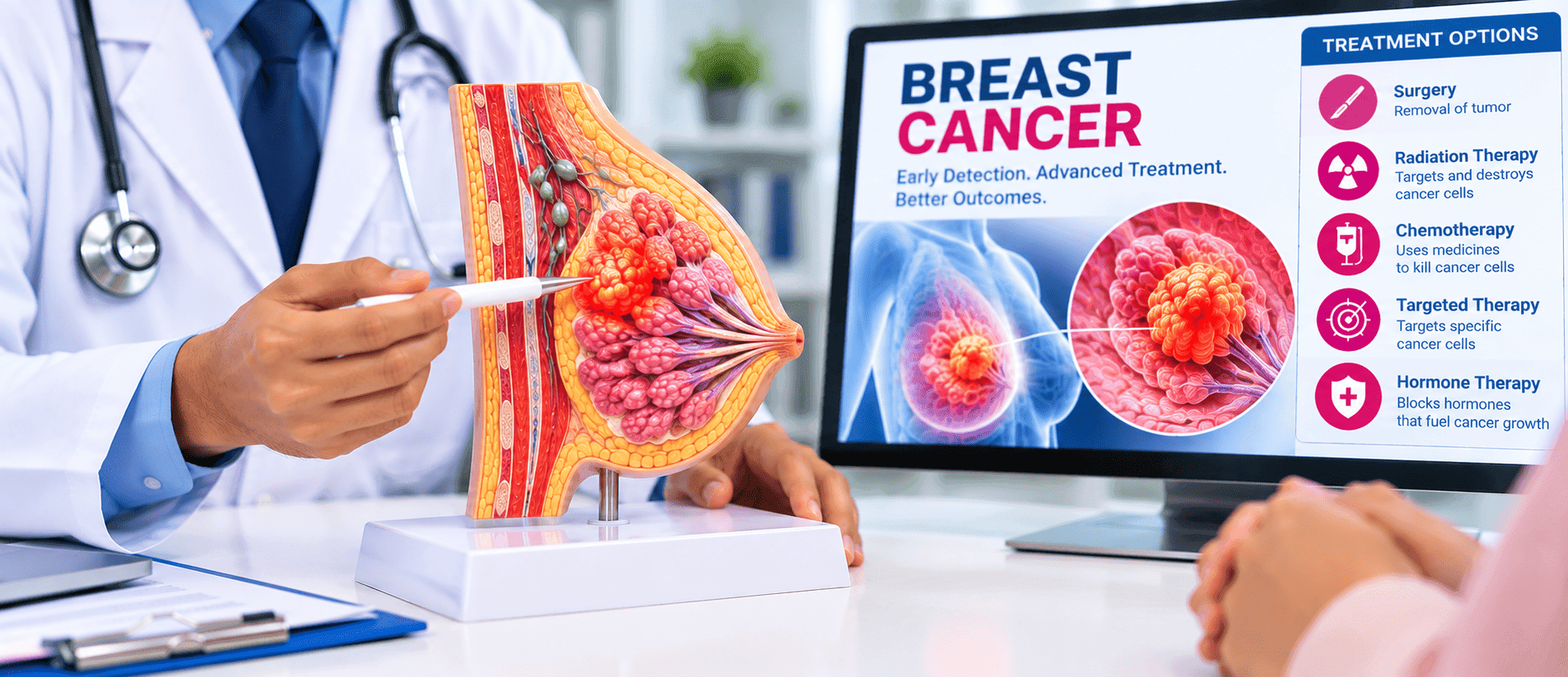
What Are the Breast Cancer Treatment Options Available in India?
Cancer centres in India offer several approaches to breast cancer treatment. A multidisciplinary team may include a breast surgeon, medical oncologist, radiation oncologist, radiologist and pathologist.
Treatment is personalised, and some patients receive medicines before surgery. Access to particular drugs and procedures varies by centre and clinical eligibility.
1. Breast Cancer Surgery
Surgery removes cancer from the breast and may include assessment of nearby lymph nodes.
- Breast-conserving surgery: Also called lumpectomy, this removes the tumour with a surrounding margin of tissue while preserving most of the breast. Radiation usually follows.
- Mastectomy: This removes the breast and may be recommended when breast conservation is unsuitable or after discussion of the patient’s preferences and risk factors.
- Lymph node procedures: Sentinel lymph node biopsy or, in selected cases, axillary lymph node dissection helps assess or treat lymph node involvement.
For suitable patients with early breast cancer, lumpectomy followed by radiation offers survival comparable to mastectomy. The surgeon explains which choices are appropriate.
2. Radiation Therapy
Radiation therapy uses high-energy radiation to destroy cancer cells in a specific area. It is commonly given after breast-conserving surgery and may be needed after mastectomy, depending on factors such as tumour size and lymph node involvement.
Radiation can also help relieve symptoms from cancer that has spread. The treatment area and schedule are planned individually.
3. Chemotherapy
Chemotherapy uses medicines to kill cancer cells or stop them multiplying. It may be given:
- Before surgery: To shrink the cancer and help guide subsequent treatment.
- After surgery: To reduce the risk of cancer returning.
- For advanced disease: To control cancer growth and relieve symptoms.
Not everyone with breast cancer needs chemotherapy. The decision depends on the cancer’s stage, subtype, recurrence risk and the patient’s health. Selected patients with early breast cancer may benefit from a genomic tumour test to help assess chemotherapy benefit.
4. Hormone Therapy
Hormone therapy, also called endocrine therapy, treats hormone receptor-positive breast cancer. It works by blocking the effects of hormones or reducing estrogen production.
Options include tamoxifen, aromatase inhibitors and, for selected premenopausal patients, ovarian suppression. Treatment may continue for several years after surgery to reduce recurrence risk.
Hormone therapy also has a role in advanced hormone receptor-positive disease. The choice depends on menopausal status, cancer characteristics and other health considerations.
5. Targeted Therapy
Targeted treatments act on specific proteins or pathways involved in cancer growth. Options may include:
- HER2-directed medicines, such as trastuzumab, for eligible HER2-positive cancers.
- CDK4/6 inhibitors, often combined with hormone therapy for selected hormone receptor-positive, HER2-negative cancers.
- PARP inhibitors for selected patients with HER2-negative cancer and inherited BRCA1 or BRCA2 mutations.
- Antibody–drug conjugates for certain cancers, depending on receptor results, stage and previous treatment.
The oncologist confirms eligibility, local approval and availability. Targeted therapies can cause significant side effects and require monitoring
6. Immunotherapy
Immunotherapy helps the immune system recognise and attack cancer cells. Pembrolizumab may be used for selected patients with triple-negative breast cancer, often alongside chemotherapy.
Suitability depends on the clinical setting, stage and relevant biomarker results. Immunotherapy is not appropriate for every patient and requires specialist monitoring for potentially serious side effects
7. Breast Reconstruction
Breast reconstruction can restore breast shape after mastectomy using implants or tissue from another part of the body. It may be performed during the mastectomy or later.
Timing depends on planned cancer treatment, health and personal preference. Reconstruction is optional.
8. Supportive and Palliative Care
Supportive care helps manage pain, fatigue, treatment side effects, nutrition concerns and emotional distress. Rehabilitation can address shoulder movement and lymphoedema, or swelling related to impaired lymph drainage.
Palliative care can be provided alongside active cancer treatment. For advanced breast cancer, care may focus on controlling the disease, relieving symptoms and maintaining quality of life.
Hospitals offering breast cancer treatment






Specialists for breast cancer treatment




Frequently asked questions
What treatment options are available for breast cancer in India?+
What treatment options are available for me, such as surgery, chemotherapy, radiation therapy, hormone therapy, targeted therapy, or immunotherapy?
Will I need surgery for breast cancer?+
How do doctors determine whether I need surgery, and can breast-conserving surgery or mastectomy be considered based on my condition?
What types of breast cancer surgery are available in India?+
Can I undergo breast-conserving surgery, mastectomy, sentinel lymph node surgery, or breast reconstruction depending on my diagnosis?
What tests do I need before breast cancer treatment?+
Will I need a mammogram, breast ultrasound, biopsy, MRI, blood tests, or other investigations to confirm the diagnosis and determine the cancer stage?
How much does breast cancer treatment cost in India?+
What is the approximate cost of breast cancer treatment in India, including diagnostic tests, surgery, hospitalization, medicines, chemotherapy, radiation, and follow-up care?
How long will I need to stay in India for breast cancer treatment?+
How many days or weeks might I need to stay in India for consultation, tests, surgery, recovery, and follow-up treatment?
How long does it take to recover after breast cancer surgery?+
How long might I need to stay in the hospital, and when can I generally return to my normal daily activities after surgery?
Can breast cancer be treated without surgery?+
If surgery is not suitable for me, can treatments such as chemotherapy, radiation therapy, hormone therapy, targeted therapy, or immunotherapy be considered?
Can I get a breast cancer treatment plan and cost estimate before travelling to India?+
Can I send my biopsy report, mammogram, scans, and other medical records to a breast cancer specialist in India and receive a preliminary treatment plan and estimated cost?
Get a personalised quote for breast cancer treatment
Share your reports — no cost, no obligation, reply within 24–48 hours.